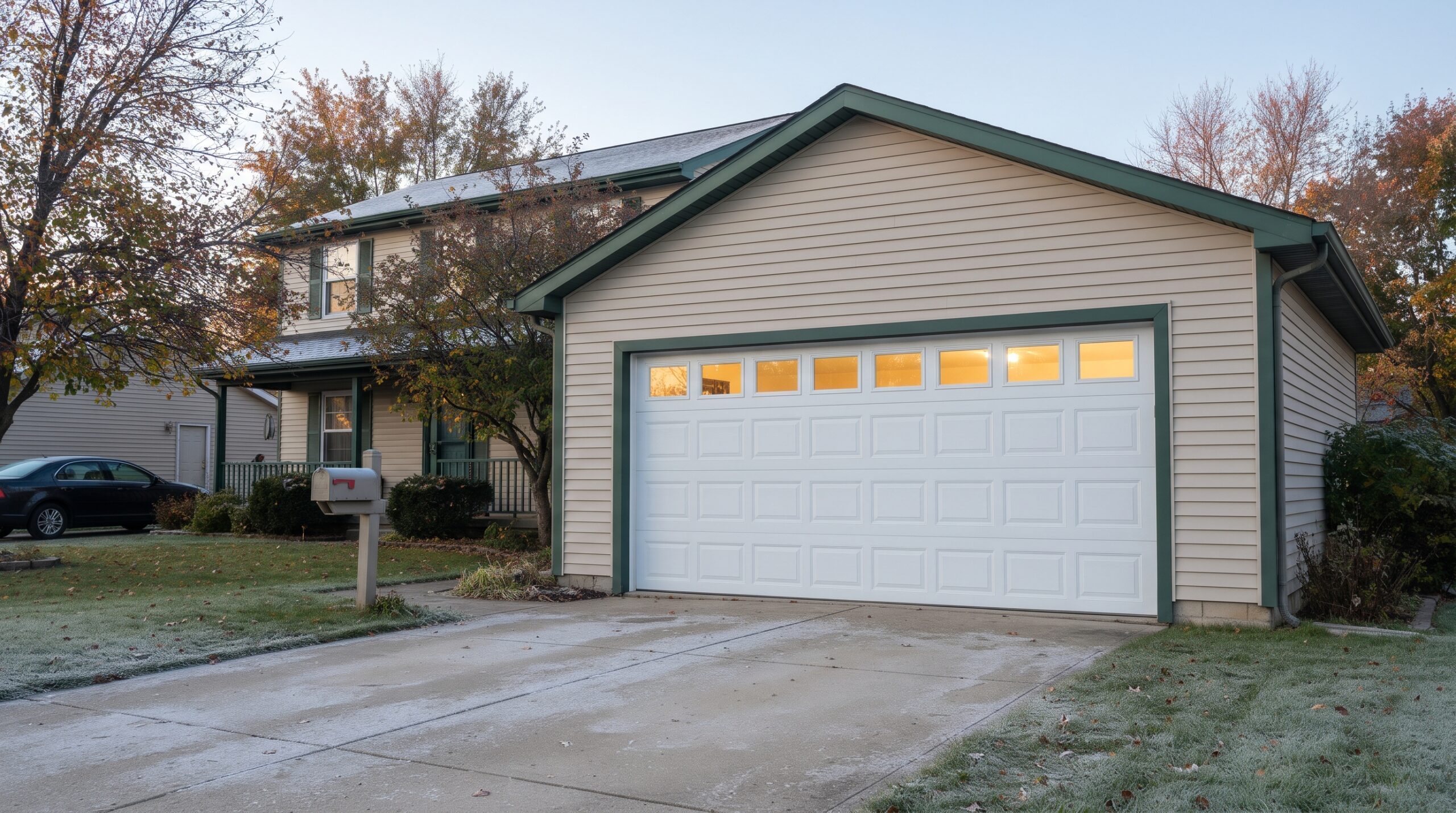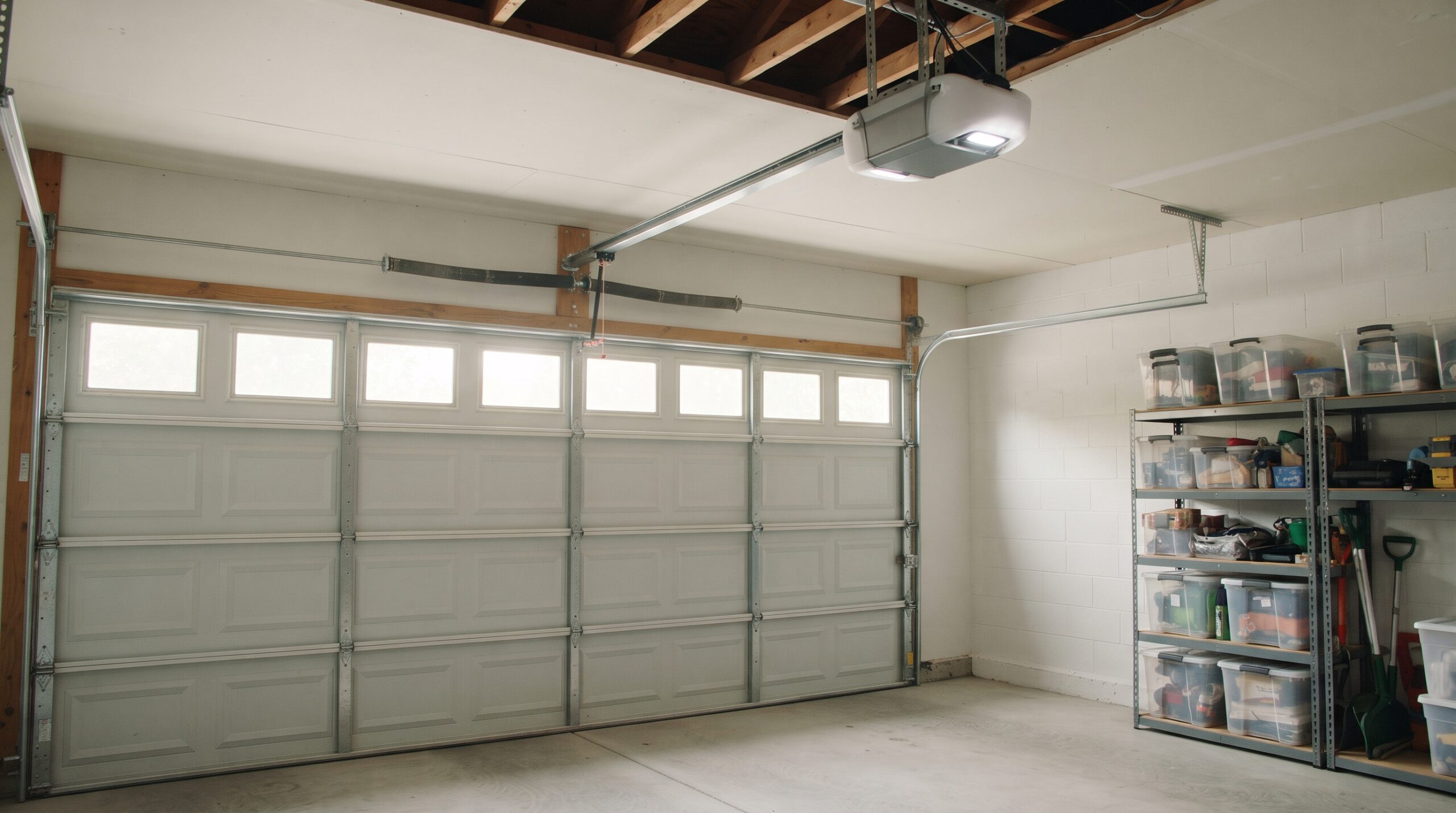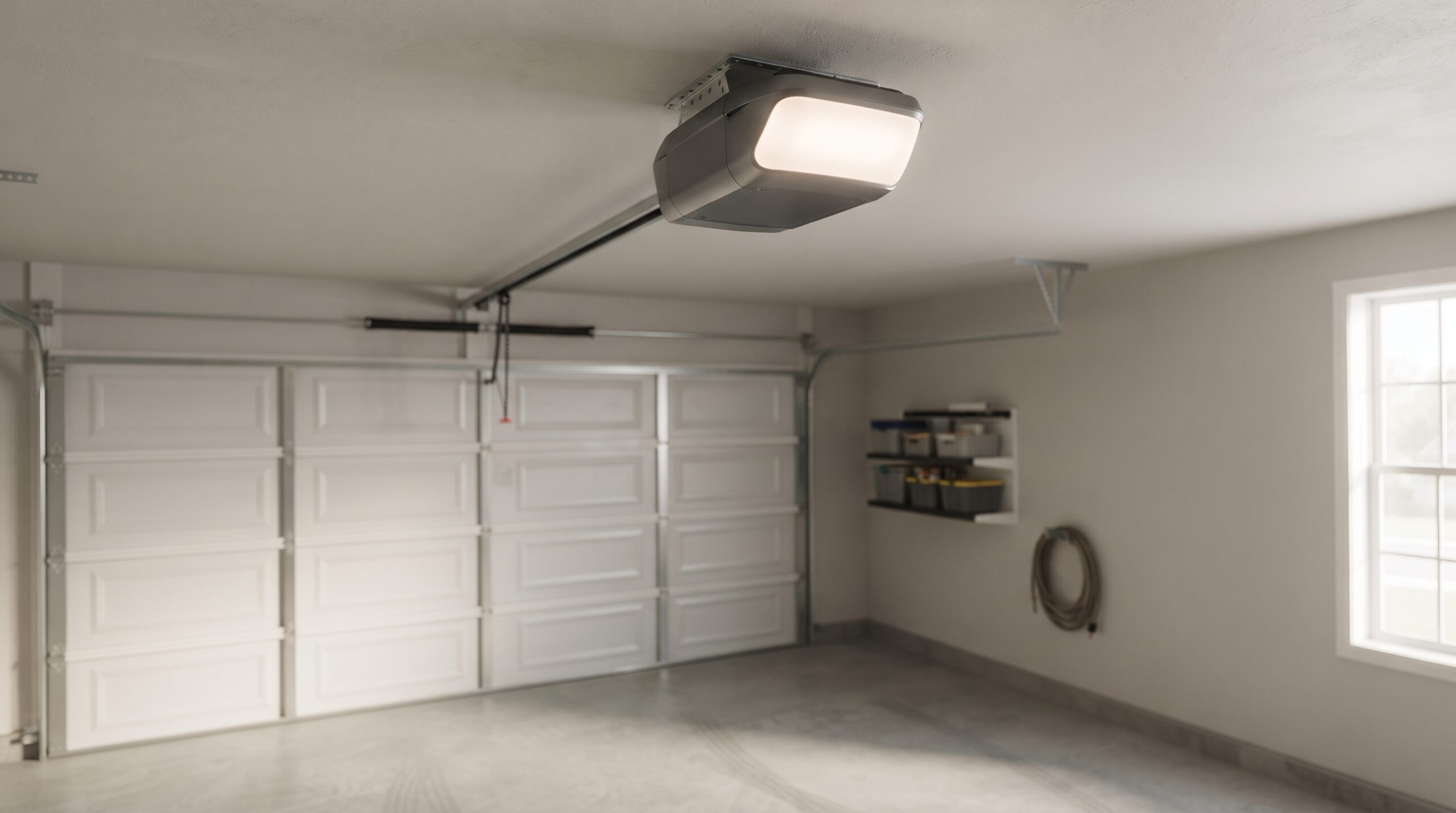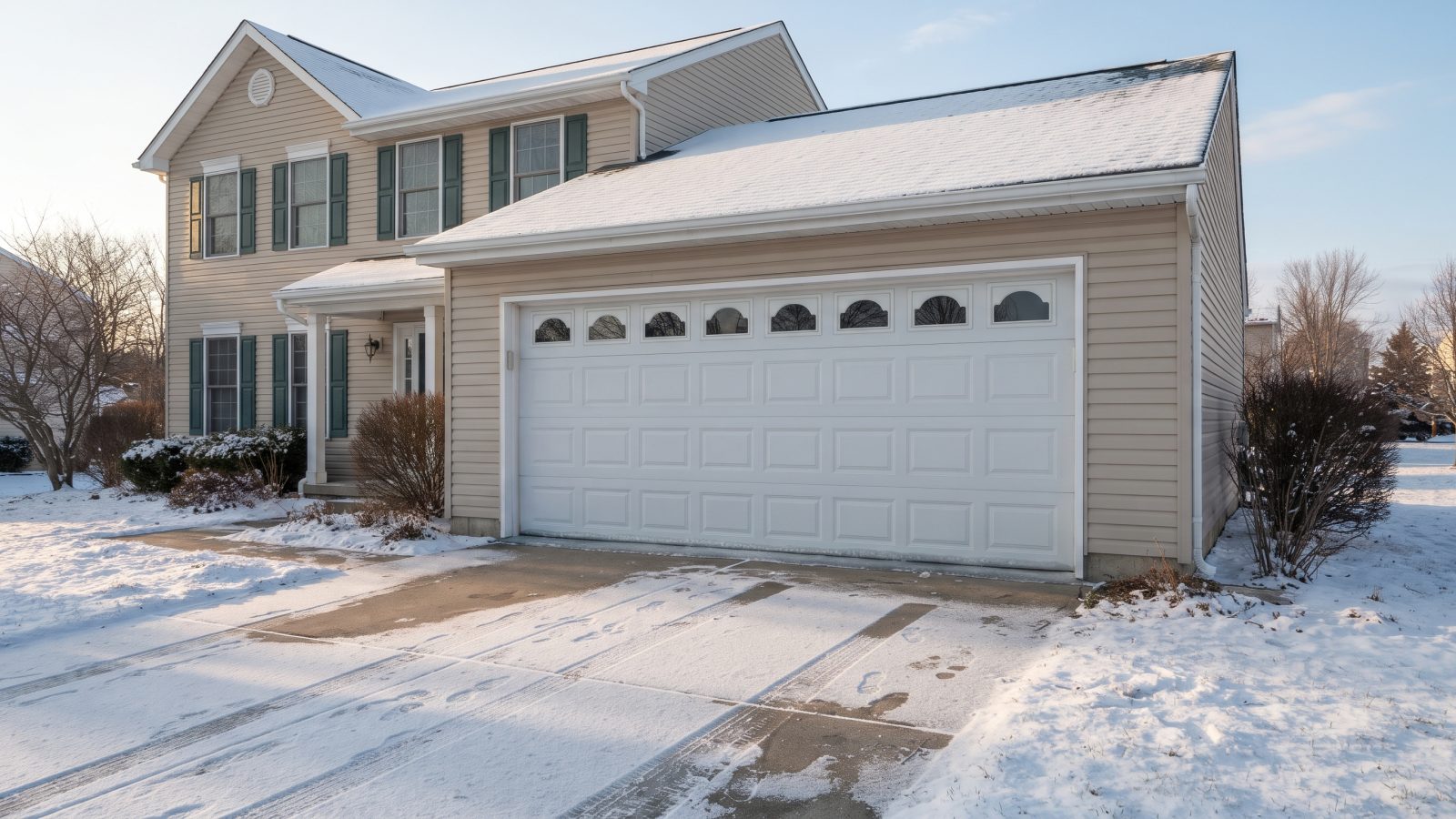
A garage door that worked fine all fall can start acting up the first week temperatures drop below freezing. In most cases the cause is one of a handful of things: a bottom seal frozen to the concrete, grease that has thickened in the cold, metal parts that bind as they contract, frosty safety sensors, or a weak battery. Most of those you can sort out yourself in a few minutes. The ones you can’t, mainly a broken spring, are jobs for a pro.
Short on time? If the door won’t budge, don’t keep hitting the button: check whether the bottom seal is frozen down, look at the springs, wipe the safety sensor lenses, and call a pro for anything involving springs or cables.
Garage door acting up in the cold?
Enter your ZIP code and we will connect you with pre-screened local garage door pros for free quotes.
Free, with no obligation to hire.
Why cold weather causes garage door problems
A garage door is a heavy, spring-balanced moving part that lives in an unheated space. When the temperature swings, a few things happen at once.
- Metal contracts. Tracks, rollers, hinges and springs all shrink slightly in the cold. Overhead Door notes that contracting tracks can bind rollers, and that cold makes steel springs less forgiving.
- Lubricants thicken. The grease on rollers, hinges and the opener rail stiffens, so the door takes more effort to move.
- Snowmelt refreezes. Water that drips off your car or runs under the door overnight can freeze the rubber bottom seal to the floor.
- Batteries lose output. Remote, keypad and wireless sensor batteries all work less well in the cold. Chamberlain’s own support page points out that cold weather can drain the battery in its wireless door sensor.
None of these are unusual. Technicians typically see a spike in calls on the first few really cold mornings of the season, and many of those turn out to be simple fixes.
Common cold-weather problems and what to do
The door is frozen to the ground
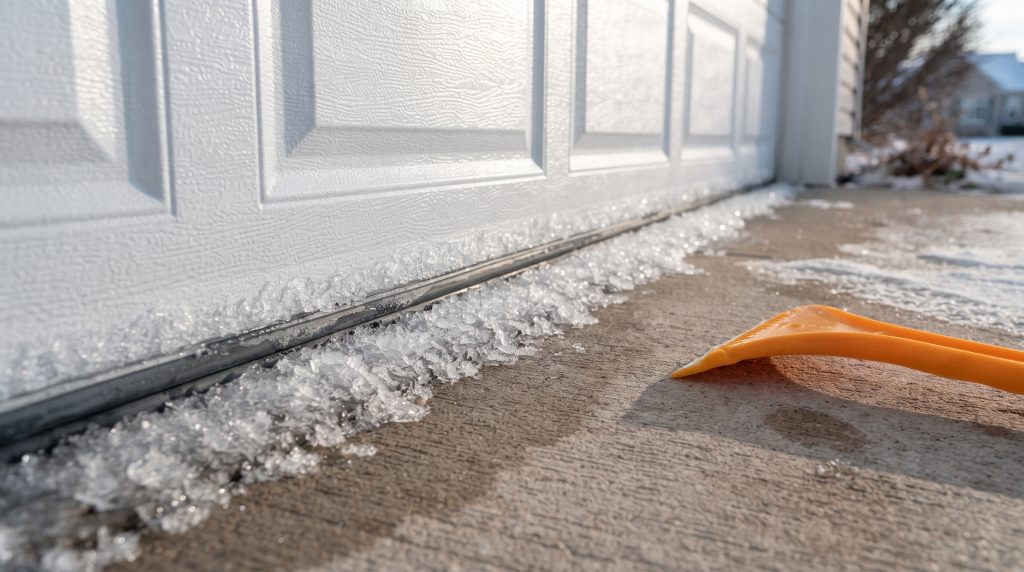
This is the classic winter problem. You press the button, the opener strains or the door lifts a few inches and stops, and the bottom seal is stuck to the concrete.
What to do: Stop pressing the button. Forcing a frozen door can tear the seal, strain the opener, or bend the bottom section. Instead, free the seal by hand: carefully chip away ice along the bottom edge with a plastic scraper, or warm it with a hair dryer. Avoid sharp tools that can cut the rubber, and don’t pour hot water on it, since that just refreezes.
To stop it happening again, clear snow and water away from the door’s threshold at night, and if the seal is cracked or flattened, replace it. A worn seal holds water against the slab. Our insulation guide also covers sealing the gaps around the door.
The door opens slowly, jerks or sounds louder than usual
Thickened grease and contracting metal both add friction. You may hear groaning, squealing or popping, and the door may move unevenly.
What to do: Run through the basics from our 15-minute maintenance check. Chamberlain recommends a small amount of garage door lubricant on the rollers, bearings and hinges, and specifically says not to lubricate the tracks. Wipe the tracks clean instead. Overhead Door advises against using WD-40 as a lubricant, because it strips the factory grease and attracts grit.
The door won’t close, or reverses on the way down
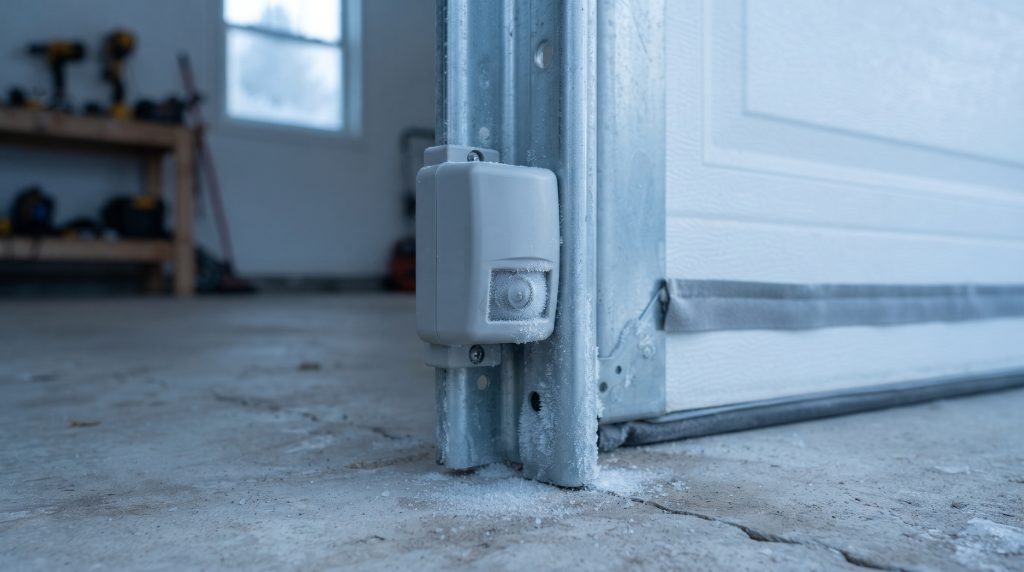
In winter, this usually comes down to one of two things.
- The safety sensors. Frost, condensation or road grime on the photo-eye lenses can block the beam. Low winter sun shining straight into a sensor can do it too. Wipe both lenses with a soft cloth and check that both indicator lights are steady. If one is blinking or off, the sensors may have been knocked out of line.
- Extra resistance. A stiff door can make the opener think it has hit something, so it reverses. Overhead Door explains that the motor can mistake stiff travel for an obstruction.
You’ll find a full step-by-step in our guide to a garage door that won’t close.
The opener hums but nothing moves
If the motor runs but the door stays put, the door may be frozen down, the opener may be disconnected from the trolley, or a spring may have broken. Pull the red emergency release cord only with the door fully closed, then try lifting the door by hand. If it feels extremely heavy or won’t lift, stop: that usually means a spring problem. Our opener hums but won’t open page walks through the rest.
The remote or keypad stops working
Weak batteries are the most common cause in cold weather. Replace the battery in the remote or keypad first. If you have a wireless door-position sensor for a smart app, replace that battery too. Still nothing? Try reprogramming the remote using your opener’s manual.
A spring breaks
Torsion springs are under a huge amount of tension, and cold weather can be the last straw for a spring that’s already near the end of its life. You’ll often hear a loud bang from the garage, and you may see a visible gap in the spring above the door.
What to do: Don’t try to open the door with the opener, and don’t adjust, unwind or replace the spring yourself. Spring and cable work can cause serious injury. Leave the door closed and call a pro. Our broken garage door spring page explains what to expect.
Quick reference: symptom, cause and fix
| Symptom | Likely cold-weather cause | What you can safely do | When to call a pro (typical cost) |
|---|---|---|---|
| Door lifts a few inches then stops | Bottom seal frozen to the floor | Free the seal with a plastic scraper or hair dryer | If the seal is torn or the bottom section is bent |
| Slow, noisy or jerky movement | Thick grease, contracting metal | Clean tracks, lubricate rollers, hinges and bearings | If it still binds: tune-up $100-$250 |
| Door reverses or won’t close | Frosty or misaligned sensors, extra resistance | Wipe lenses, check sensor lights | Sensor repair $100-$250; opener repair $100-$350 |
| Opener hums, door doesn’t move | Frozen door, disconnected trolley, broken spring | Check for ice, test the door by hand | Broken spring: torsion spring $180-$350 |
| Remote or keypad dead | Weak battery | Replace the batteries | If new batteries don’t help: opener repair $100-$350 |
| Loud bang, door very heavy | Broken spring | Leave the door closed | Always a pro job: $180-$350 |
Most repair visits fall in the $150-$350 range, and many companies charge a service call of $50-$150 on top. Our repair cost guide breaks down the numbers in more detail.
A word about the opener’s force setting
When a door starts reversing in the cold, it’s tempting to turn up the opener’s force setting. Don’t do that to cover up a problem. DASMA, the door industry’s trade association, says increasing force should never be used to compensate for a door that isn’t balanced or doesn’t move smoothly. A door that needs more force has a mechanical problem, and higher force means the door pushes harder on anything, or anyone, in its way.
If the door is clean, lubricated and balanced and still reverses, have a technician check it. If you do make any opener adjustment yourself following your owner’s manual, run the safety reversal test straight afterward.
Your winter garage door checklist
Do this once as the weather turns cold, and repeat the reversal test monthly.
- Look at the springs. From the floor, check the springs above the door for gaps, rust or stretched coils. Look, but don’t touch.
- Check the bottom seal. Replace it if it’s cracked, stiff or flattened.
- Clean the tracks. Wipe out dirt and old grease. Don’t grease the tracks.
- Lubricate the moving parts. Use a garage door lubricant on the rollers, hinges and bearings.
- Wipe the sensor lenses. Make sure both indicator lights are steady.
- Replace batteries. Remotes, keypad and any wireless door sensor.
- Test the balance. With the door closed, pull the release cord and lift the door to about halfway. A balanced door stays roughly in place. If it falls or shoots up, call a pro.
- Run the safety reversal test. Chamberlain and DASMA both say to place a 1-1/2 inch object, such as a 2×4 laid flat, on the floor under the center of the door and close it. The door must reverse when it hits the board. If it doesn’t, stop using the opener until it’s fixed.
- Know your manual release. If a winter storm knocks out power, here’s how to open your garage door when the power is out.
The reversal feature matters. Federal rules require openers made since January 1, 1993 to have entrapment protection, such as photo-eye sensors, and the CPSC has long urged owners to test it monthly.
When it’s time to call a pro
Call a technician if you hear a loud bang and the door won’t lift, a cable looks frayed or loose, the door hangs crooked or has come off its track, or it still won’t run smoothly after cleaning and lubrication. Don’t run the opener with a broken spring or cable. Not sure what you’re looking at? Our problem solver can help you narrow it down.
Get quotes from local pros
Tell us what you need and we’ll connect you with pre-screened local garage door pros. It’s free, and there’s no obligation.
Get quotes from local pros
Tell us what you need and we will connect you with pre-screened local garage door pros. It is free, and there is no obligation.
Free, with no obligation to hire.
Frequently asked questions
Why won’t my garage door open when it’s cold?
The most common reasons are a bottom seal frozen to the floor, stiff grease, or a broken spring. Check for ice along the bottom edge first. If the door is free but still won’t lift, a spring may have broken.
Can I pour hot water on a frozen garage door?
It’s better not to. The water runs under the door and refreezes, often making the problem worse. A hair dryer or careful scraping with a plastic tool is safer.
Do garage door springs break more in winter?
Many technicians see more broken springs in cold weather. Cold doesn’t usually break a healthy spring, but it can finish off one that’s already worn. Spring replacement should always be done by a pro.
Should I turn up the force on my opener in winter?
No. Raising the force to push a stiff or unbalanced door is unsafe. Fix the cause instead: free the seal, clean and lubricate the door, and have a pro check the balance and springs.
What lubricant should I use on my garage door in cold weather?
Use a lubricant made for garage doors on the rollers, hinges and bearings. Don’t grease the tracks, and don’t rely on WD-40 as a lubricant. Check your opener’s manual before greasing the opener rail.
How much does it cost to fix a garage door that broke in the cold?
It depends on the problem. A torsion spring typically runs $180-$350, sensor repairs $100-$250, and opener repairs $100-$350. A preventive tune-up costs about $100-$250.
Sources
- Overhead Door: Garage Door Won’t Open or Close in Cold Weather
- Chamberlain: How to Test the Safety Reversal System
- Chamberlain: Garage Door Opener Recommended Maintenance
- Chamberlain: How to Resolve a Close Error in the myQ App
- DASMA: Paper Towels vs. 2x4s
- CPSC: Safety Commission Publishes Final Rules for Automatic Garage Door Openers